Overview: Why alsDB?#
alsDB is a scalable Python package built to simplify working with Airborne Laser Scanning (ALS) point clouds from any national or global dataset. It reads LAZ/LAS files, stores them efficiently in a TileDB sparse array, and provides a complete pipeline for deriving forest structure products.
The motivation behind alsDB#
Working with raw LAZ point clouds at scale presents several challenges:
Fragmented files: National ALS campaigns deliver thousands of tiles that must be ingested, indexed, and queried as a unified dataset.
Multi-temporal surveys: Many regions have been flown multiple times; storing and querying per-year data without file duplication requires a purpose-built schema.
Expensive HAG computation: Height-above-ground requires a Delaunay TIN from ground points and is sensitive to tile-edge artefacts if tiles are processed in isolation.
Raster mosaic overhead: Traditional pipelines produce per-tile GeoTIFFs that must be mosaiced into a final product: a slow, storage-intensive step that duplicates data.
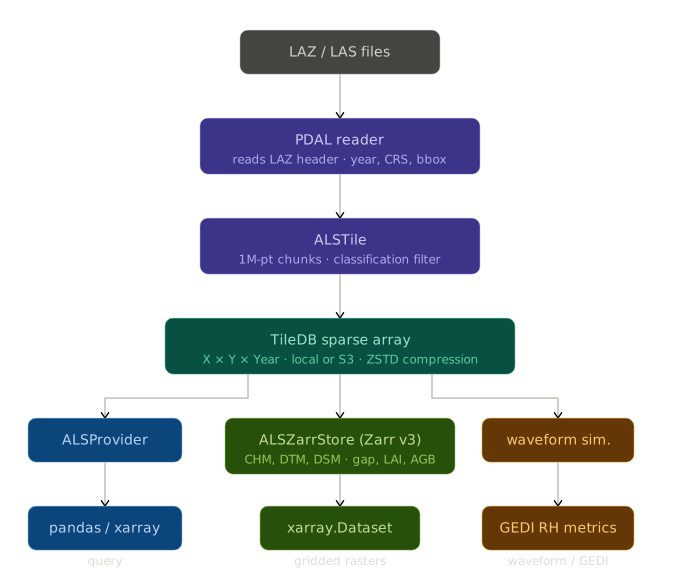
alsDB was designed to address all of these by combining a TileDB sparse array for point storage with a Zarr v3 store for gridded outputs, connected by a tiled processing engine that handles buffering, parallelism, and idempotency automatically.
What alsDB enables#
Unified multi-temporal point cloud: All survey years in one TileDB array, queryable by bounding box and year.
Direct-to-Zarr processing: CHM, DTM, DSM, gap fraction, LAI, structural metrics, and biomass are written tile-by-tile directly to the output store: no GeoTIFF intermediates, no mosaic step.
Dataset-agnostic ingestion: CRS, bounding box, and acquisition year are read from the LAZ header automatically. Any national or global ALS dataset works without a custom parser.
Scalable tiling: Large areas are split into sub-tiles with configurable size and buffer. Processing is parallel via a
ThreadPoolExecutorwithn_workers.Large-footprint waveform simulation: Sensor-agnostic full-waveform simulation (GEDI, LVIS, GLAS) at configurable footprint scale for direct comparison with space-borne LiDAR.
Pipeline output: a 1 km² tropical forest tile#
The figure below shows the full alsDB pipeline applied to a Brazilian ALS survey (2014). From a single TileDB query the package derives a 1 m Canopy Height Model, a hill-shaded DTM, aboveground biomass at two resolutions, and a GEDI-like waveform with RH metrics.
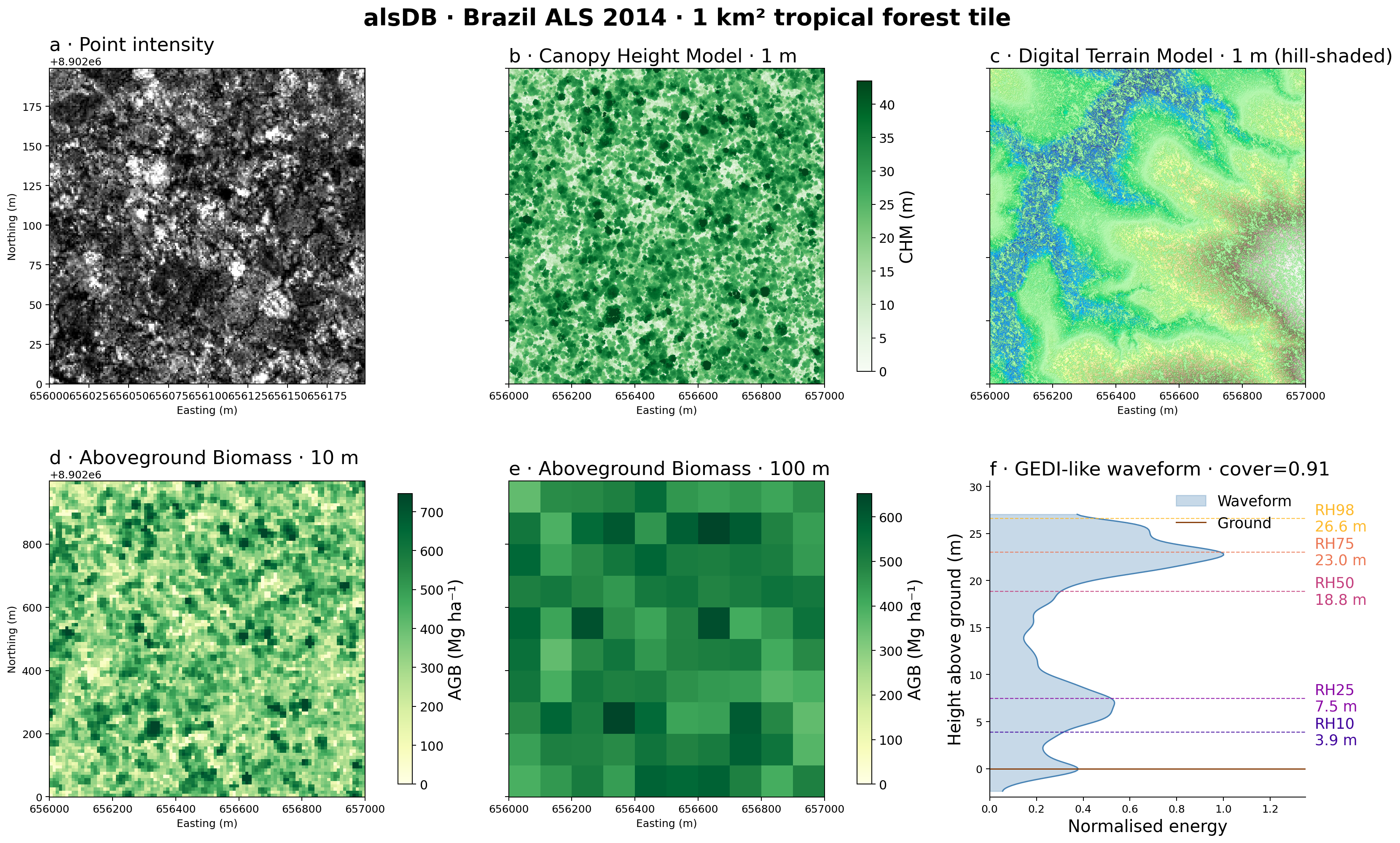
alsDB output for a 1 km² tropical forest tile. (a) Raw point cloud intensity (200 × 200 m sub-area). (b) Canopy Height Model at 1 m resolution. (c) Digital Terrain Model at 1 m with hill-shading. (d) Aboveground biomass at 10 m resolution. (e) Aboveground biomass at 100 m resolution. (f) Simulated GEDI-like waveform with RH10–RH98 annotations.#
The two storage layers#
alsDB uses two complementary storage backends:
- TileDB sparse array (point clouds)
Each LAZ tile is ingested into a 3-D sparse array with dimensions
X(float64),Y(float64),Year(int16). Multiple survey years coexist in the same array. Spatial domain bounds are selected automatically per CRS. ByteShuffle + ZSTD compression is applied to float attributes; DoubleDelta + ZSTD to the Year dimension. Each ingested tile creates a new fragment; fragments are consolidated periodically to keep read performance healthy.- Zarr v3 store (gridded products)
All processing outputs are written to an
ALSZarrStore: a Zarr v3 hierarchy organised by resolution (1m/,10m/) with a time axis for multi-year products. Sub-tiles write directly to non-overlapping spatial slices in the shared arrays, so the product is complete as soon as the last tile finishes.
See alsDB Fundamentals for a detailed explanation of both layers and how they interact.
Core components of alsDB#
alsdb.ALSDatabase: manages ingestion: LAZ → TileDB fragments, with a manifest for idempotency, parallel workers, and periodic consolidation.alsdb.ALSProvider: queries the TileDB array by bounding box and year, returning results aspandas.DataFrameorxarray.Dataset.ALSZarrStore: the gridded output store. Accepts tile writes from all processing functions and exposes the result viato_dataset()as a CRS-awarexarray.Dataset.processing.*: modular processing functions:alsdb.processing.chm: Canopy Height Model, DTM, DSMalsdb.processing.gap: gap fraction, effective LAIalsdb.processing.biomass: structural metrics, aboveground biomassalsdb.processing.waveform: large-footprint waveform simulation (GEDI by default)
Goals and aspirations#
alsDB’s primary objective is to provide a reproducible, scalable platform for forest structure research from ALS data, including:
Forest structure monitoring: Multi-temporal CHM, biomass, and LAI for tracking forest change.
GEDI validation: Simulated waveforms at GEDI footprint scale for validating space-borne retrievals against airborne reference data.
Machine-learning pipelines: Structural metric grids ready for training and predicting biomass or species composition models.
—
A project from GFZ Potsdam#
alsDB was developed by Simon Besnard from the Global Land Monitoring Group at the Helmholtz Centre Potsdam GFZ German Research Centre for Geosciences. It builds on design principles established in the GEDI-focused gedidb and ICESat-2-focused icesat2db packages and adapts them to the challenges of national ALS campaigns. The project is open-source (EUPL-1.2) and welcomes contributions from the research community.
—